Categories
Parenting Parenting Parenting Parenting

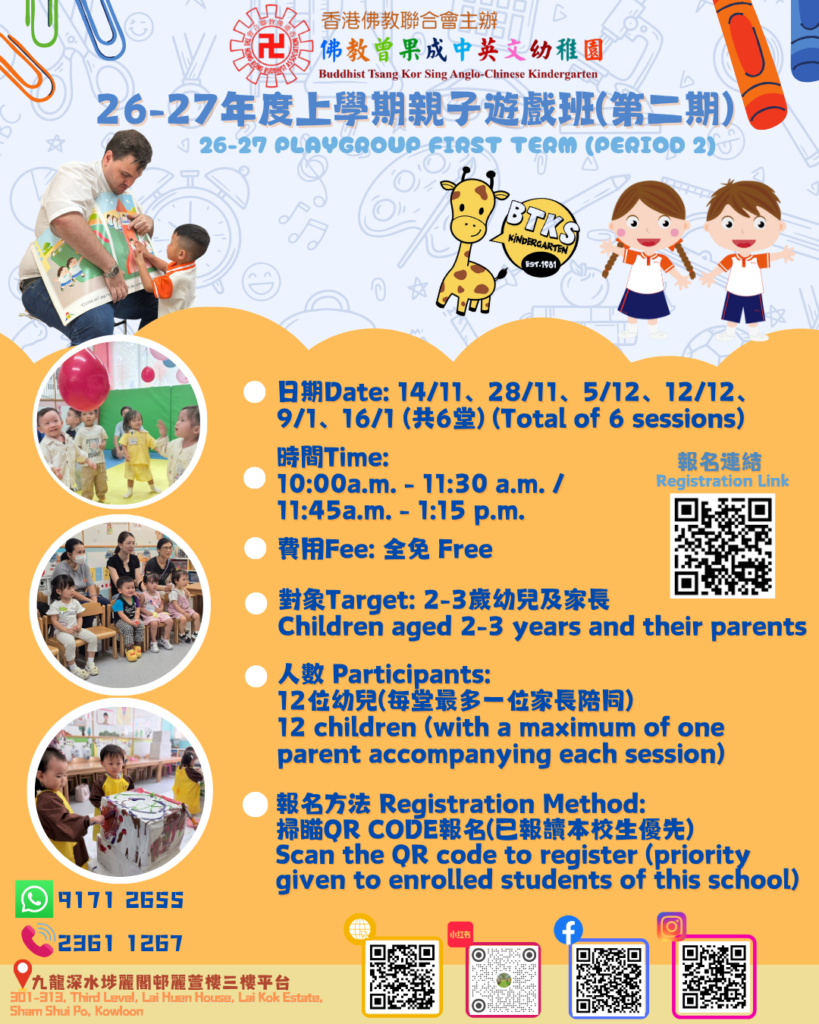
2026–2027 First Term Parent-Child Playgroup (Phase 2) | Now Open for Applications!

 
🎈👶 26-27年度上學期親子遊戲班(第二期)|現正接受報名!
感謝各位家長支持!本校 26-27年度上學期親子遊戲班(第一期)🎈 反應熱烈🌟,現加開 第二期,誠邀2-3歲幼兒及家長一同參與!透過多元化的親子活動,讓孩子在輕鬆愉快的氛圍中體驗校園生活,為入學做好準備!🥰✨
📋 活動詳情
📅 日期:14/11、28/11、5/12、12/12、9/1、16/1(共6堂)
⏰ 時間:10:00 – 11:30 / 11:45 – 1:15
💰 費用:全免
👶 對象:2-3歲幼兒及家長
🎯 人數:12位幼兒(每堂最多一位家長陪同)
📝 報名方法:請掃描海報上的二維碼
💖 名額有限・報名從速!
記得一齊嚟玩啦!期待與您和孩子共度愉快的親子時光!🎉👨‍👩‍👧‍👦

🎈👶 2026–2027 First Term Parent-Child Playgroup (Phase 2) | Now Open for Applications!
Thank you for your enthusiastic support! Following the overwhelming response to our 2026–2027 First Term Parent-Child Playgroup (Phase 1)🎈🌟, we are pleased to launch Phase 2! We cordially invite children aged 2–3 and their parents to join us! Through diverse parent-child activities, children can experience school life in a relaxed, joyful environment and be well prepared for school entry! 🥰✨
📋 Event Details
📅 Dates: 14/11, 28/11, 5/12, 12/12, 9/1, 16/1 (6 sessions in total)
⏰ Time: 10:00 a.m. – 11:30 a.m./ 11:45 a.m. – 1:15 p.m.
💰 Fee: Free of charge
👶 Target Audience: Children aged 2–3 and their parents
🎯 Quota: 12 children (Maximum of one parent accompanying per session)
🔗 Registration Link: Please scan the QR code on the poster
💖 Limited Quota · Register Now!
Come and join the fun! We look forward to sharing wonderful parent-child moments with you and your child! 🎉👨‍👩‍👧‍👦

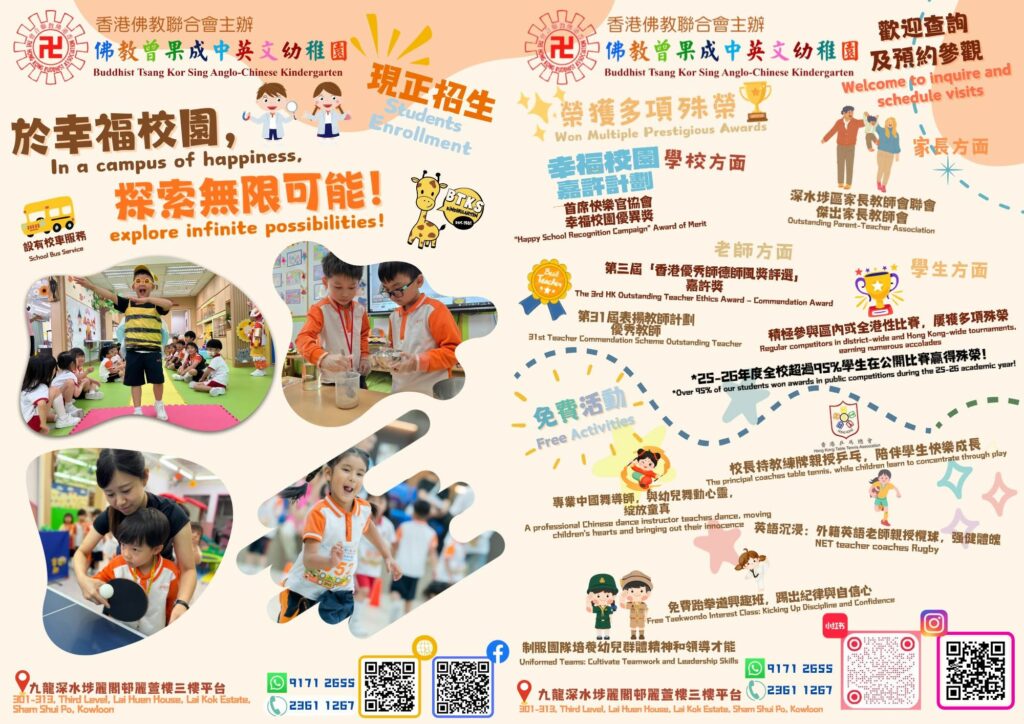
Enrollment Now Open | Explore Infinite Possibilities in a Campus of Happiness!

🌟🎒 現正招生|於幸福校園,探索無限可能!

本校現正開始招生,誠邀各位家長為 貴子女選擇一個充滿愛與啟發的學習環境,讓孩子在一所幸福校園中,展開愉快而充實的學習旅程!🏫💖✨

我們重視每一個孩子的獨特性,致力提供多元化課程及豐富學習體驗,讓幼兒在探索中成長,在遊戲中學習!🌈👶📚

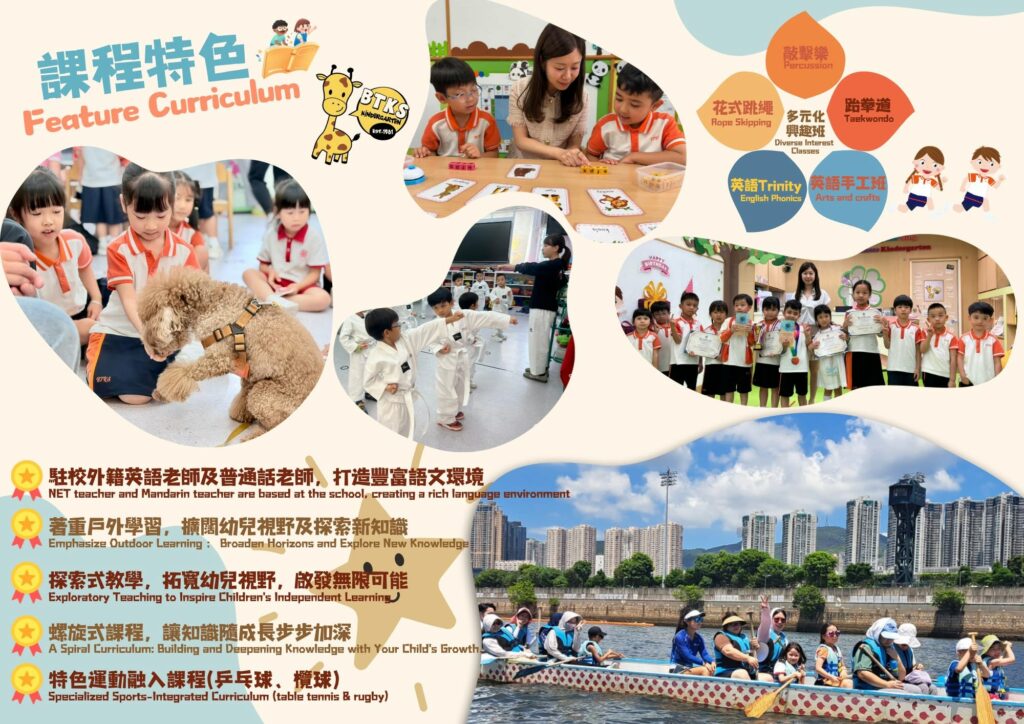
🌟 課程特色亮點

✅ 多元化興趣班

花式跳繩、跆拳道、英語Trinity、敲擊樂、英語手工班,發掘幼兒潛能,培養多元興趣!🎵🎨🏅

✅ 探索式教學

透過親身探索與實驗,激發幼兒好奇心與創造力,拓寬視野,啟發無限可能!🔍💡

✅ 螺旋式課程設計

課程隨幼兒成長逐步深化,讓知識穩固累積,學習更紮實!📚🌱

✅ 豐富語文環境

設有駐校 籍英語老師及普通話老師,讓幼兒在自然語境中輕鬆接觸雙語,建立良好語感!🗣️💬

✅ 特色運動課程

將乒乓球及欖球融入課程,讓幼兒在運動中學習團隊合作與堅毅精神!🏓🏉

✅ 著重戶外學習

定期安排戶外探索活動,擴闊幼兒視野,讓學習不限於課室之內!🌳🌍

💖 歡迎預約參觀

想了解更多本校的課程特色與校園環境?歡迎預約參觀,親身感受我們的教育理念!🏫💕

我們相信,每個孩子都值得在愛與鼓勵中成長。期待您與孩子成為佛教曾果成中英文幼稚園的一份子,一同展開快樂學習之旅!🌈🎒💖

📞 查詢及預約:歡迎致電本校2361 1267與校務處職員聯絡

🌟🎒 Enrollment Now Open | Explore Infinite Possibilities in a Campus of Happiness!

Admissions for the upcoming academic year are now officially open! We cordially invite parents to choose a learning environment filled with love and inspiration for your child, allowing them to embark on a joyful and rewarding learning journey within our happy campus! 🏫💖✨

We value the uniqueness of every child and are committed to providing a diversified curriculum alongside rich learning experiences, enabling young learners to grow through exploration and learn through play! 🌈👶📚

🌟 Curriculum Highlights ✅ Diversified Interest Classes: Rope Skipping, Taekwondo, Trinity English, Percussion Music, and English Arts & Crafts—discovering young potential and nurturing diverse interests! 🎵🎨🏅

✅ Exploratory Learning Inspiring children’s curiosity and creativity through hands-on exploration and experimentation, broadening their horizons, and unlocking infinite possibilities! 🔍💡

✅ Spiral Curriculum Design Our curriculum progressively deepens with your child’s development, ensuring solid knowledge accumulation and a firm learning foundation! 📚🌱

✅ Rich Language Environment Resident Native English Teachers (NETs) and Putonghua teachers provide an authentic language context, allowing children to acquire bilingual skills effortlessly and develop excellent language proficiency! 🗣️💬

✅ Signature Sports Program: Integrating Table Tennis and Rugby into our curriculum, encouraging children to learn teamwork and perseverance through physical activities! 🏓🏉

✅ Focus on Outdoor Learning: Regular outdoor exploration activities are arranged to expand children’s perspectives, taking learning beyond the boundaries of the classroom! 🌳🌍

💖 Welcome to Book a School Visit. Eager to learn more about our curriculum features and school environment? You are warmly welcome to schedule a visit and experience our educational philosophy firsthand! 🏫💕

We believe that every child deserves to grow in an environment filled with love and encouragement. We look forward to welcoming you and your child to Buddhist Tsang Kor Sing Anglo-Chinese Kindergarten, where we can embark on a joyful journey of learning together! 🌈🎒💖

📞 Enquiries & Appointments: Please feel free to call our General Office at 2361 1267.

To love children, first to love themselves, 3 moves to teach you to maintain the best mental state

Parenting

Written by :Family Dynamics Child Play Therapist
                   Marriage and Family Therapist, Ms. Lee Wai Zi

In today’s society, it is indeed not easy for parents to maintain a good state of mind and body. I have met with many parents and found that the difficulty most parents face is not that they do not understand their children’s feelings and needs, or that they do not know how their behavior affects their children, but that it is difficult to maintain a trusting and optimistic attitude towards their children when they are in a situation. Often, parents become increasingly anxious as they worry that their child’s problems will continue and worsen, and repeat ineffective ways of dealing with their child’s problems.

So, how can parents maintain the best mental state to face the stress and challenges of disciplining their children? Here are some tips for parents to consider:

1. Be more sensitive to your own stress levels
Parents are human beings, so there will be times when they are depressed or physically and emotionally exhausted. The purpose of parents being sensitive to their own mental state is to remind themselves that they need to take care of their own needs first. It is difficult for parents to be sensitive and responsive to the needs of their children when they are in a highly stressed state. Conversely, inappropriate responses may harm the child and damage the parent-child relationship.

2. Use resources effectively to relieve stress
When parents feel stressed, they should try to explore and make good use of their own internal and external resources to regulate their negative emotions. For example, find family members or friends to talk to, do things that can relax you, and find positive thoughts and beliefs to encourage you. The purpose is to give yourself a proper rest and temporary relief from stress.

3. Turn your mind around and reflect
If a parent’s stress continues and increases, professional help is needed. Sometimes, these pressures come from more than just external influences. Parents’ self-worth, worldview, and perceptions of things can affect how we parent. For example, some parents worry that they are not doing enough to fulfill their parental responsibilities and end up pushing their children to study or participate in activities, or even that they are not flexible enough to respond to their children’s needs when they are stressed and negative. If

parents are aware of and take care of their own feelings and needs, they can prevent their negative emotions from affecting the next generation.

Therefore, parents who love their children must first love themselves. Only when parents are healthy and happy can their children grow up healthy and happy.

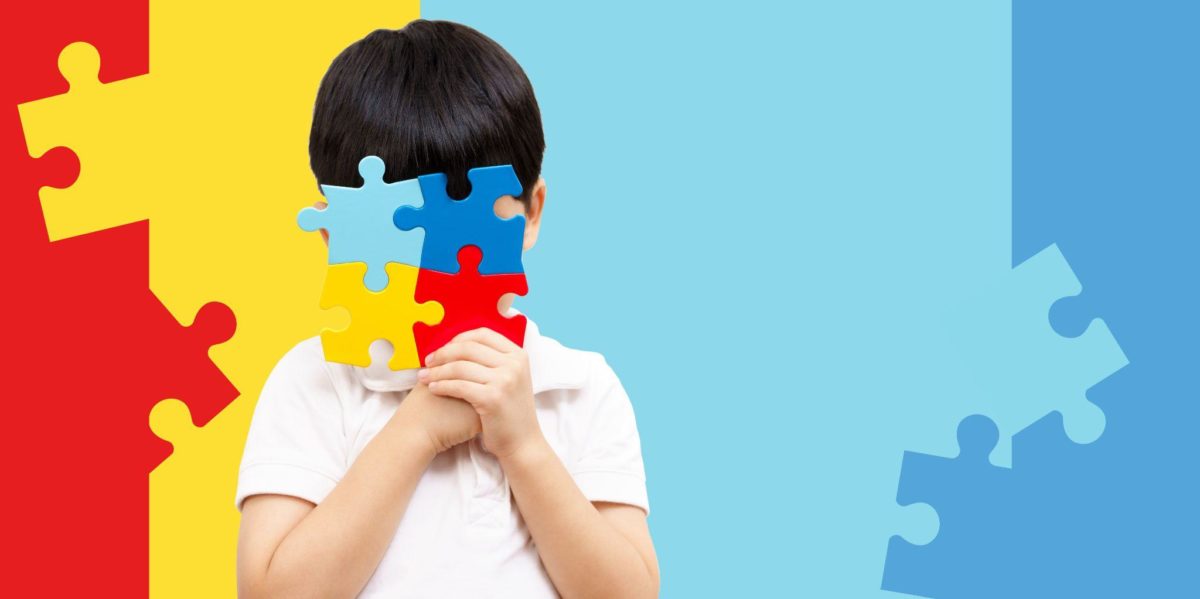
Wear face mask for long time during Epidemic. How to make children learn to “look at people’s eyebrows and eyes”?

Parenting

Written by: Hong Kong Speech and Swallowing Therapy Centre
Senior Speech Therapist Eunice Siu

In our daily interactions with others, we not only observe others’ behaviors, but also “explain” and “predict” others’ behaviors. Theory of mind is the ability to infer or substitute other people’s mental states, such as their thoughts, beliefs, desires, and intentions, etc., and to use this ability to explain other people’s thoughts, perceptions, and predict their behaviors. Theory of mind can be subdivided into “emotion recognition”, “beliefs” and “pretend play”.

The developmental period for children’s theory of mind is from approximately 3 to 7 years of age. However, before the age of 3, children need to master the following skills to effectively develop theory of mind skills.

1. noticing and imitating the behavior of people around them
2. recognizing the emotions of others and using words to express them (e.g., happy, sad, angry, surprised)
3. participates in pretend play
4. understands that different people have different desires and preferences
5. understands that people will act to get what they want (e.g. reach for candy)
6. understands the causes and consequences of unsympathetic emotions (e.g. if I hit my brother, my mom will be mad and then she will scold me)

Ways to improve theory of mind are:

1. Use more psychologically relevant words when talking to your child

Using psychologically related words to communicate with children can help children understand their own and others’ psychological conditions more specifically. Examples of psychologically related words are “think,” “pretend,” “know,” “believe,” “feel,” and words related to emotions. Pay attention to what your child is trying to say and then respond. For example, “Ah! You want cake”, “Don’t be afraid! You think I’m gone, but I’m still here,” and “Mommy’s mad at you for hitting your brother. Parents can also explain to their children the psychological situation of others, e.g., “Mei-mei is smiling so much when she receives a birthday present, she should be very excited.

2. Participate in role-playing games with your child

Role-playing games encourage children to put themselves in different situations and characters’ perspectives to draw inferences about their behavior. To begin, children can pretend to be common everyday characters, such as mothers, doctors, teachers, and drivers. Parents should pay attention to the fact that both the words and behaviors in the game should be substituted for the role played. This activity helps children experience a variety of emotions, thoughts and interactions in different social situations, and learn to observe, imitate, anticipate, review and adjust their thoughts and behaviors.

I hope parents can make good use of the opportunity to share and communicate more with their children in daily life, so that they can learn to “look at people’s eyebrows and eyes” (meaning read people’s faces) and become a “mind-reading detective”!

Source:
Hollin, P., Baron-Cohen, S.,& Hadwin,J.(1999). Teaching children with autism tomind-read. West Sussex, England: Wiely Press

Lowry, L.(2015).” Tuning in” to others: How young children develop theory of mind. The Hanen Centre.

Spastics Association of Hong Kong (2005). Connecting: Developing social skills in children with autism. Spastics Association of Hong Kong.